
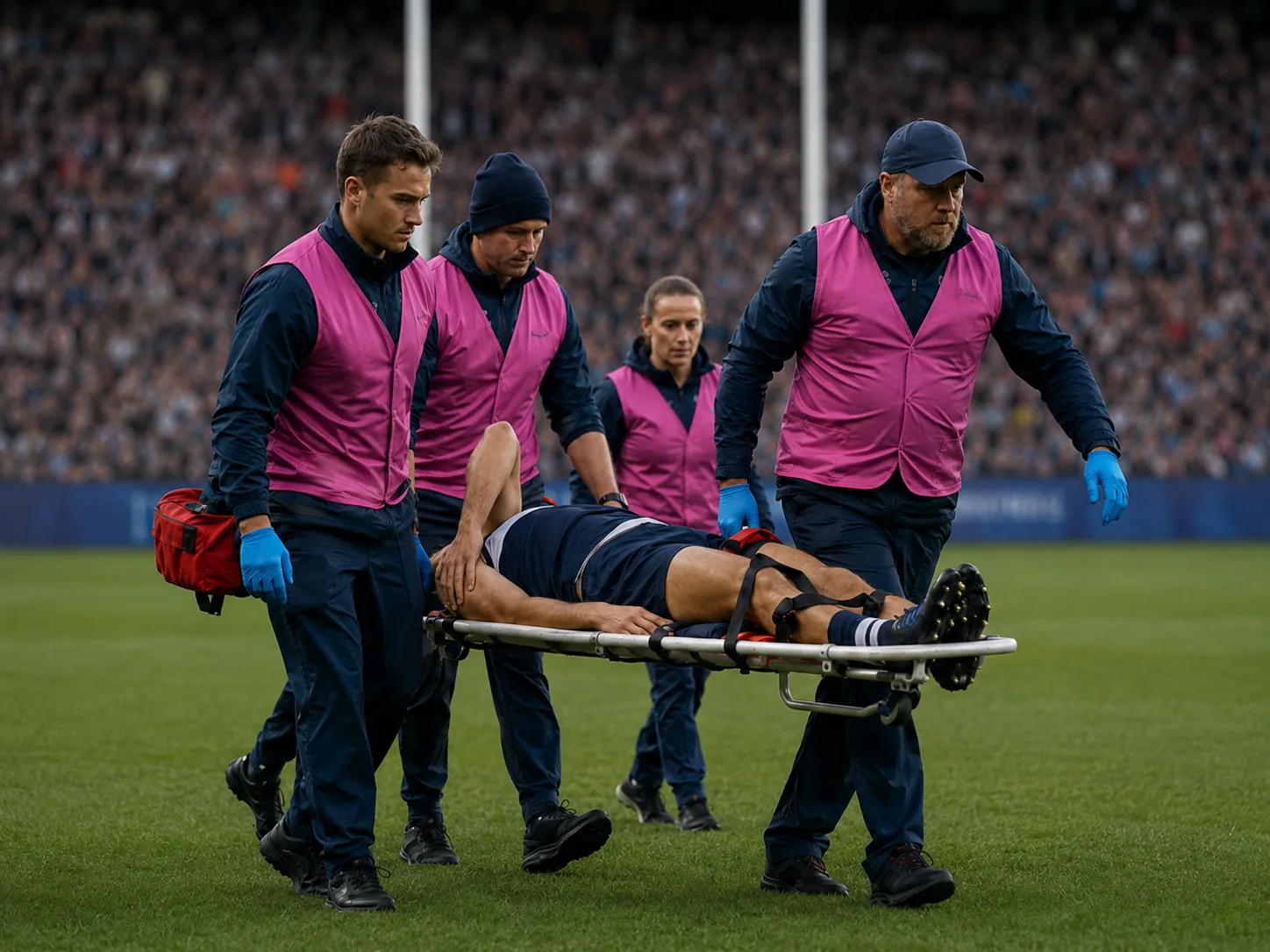

Australian football is a contact sport, which is fast, physical and demanding. The athletes who play it are courageous and put their bodies on the line. In recent years, the long-term effects of repeated head knocks have become one of the sport’s defining issues, and a conversation that began as a medical concern, has now evolved into a legal and financial one. As an accredited player manager, a question I hear often from players and their families is: When the game leaves you with loss and damage that can run over a lifetime, is the support on offer actually enough?
what the science shows about concussion in sports
A Four Corners investigation broadcast on 29 June 2026 revealed that the Australian Sports Brain Bank has now identified chronic traumatic encephalopathy (CTE) in 33 former Australian Rules players, including 19 who played at professional or semi-professional level. CTE is a degenerative brain disease linked to repeated head trauma. It can currently only be confirmed by examining brain tissue after death, and it has been associated with depression, memory loss, aggression and suicidal thoughts.
How the AFL has responded
Since 2005, the AFL has introduced more than 30 rule changes aimed at reducing head knocks. These range from rules around tackling and protecting the player’s head, as well as tighter concussion protocols, including in 2026 the introduction of independent spotters with the power to have a player removed from the field.
In addition, players who suffer injuries during a game or at training receive payments for missed games under the Collective Bargaining Agreement (CBA). There is a no-fault compensation scheme for AFL and AFLW players through the Injury and Support Fund (the “Fund”). Within the Fund, sits a Severe Injury Benefit of up to $600,000 for players who demonstrate a loss of earning capacity of 40% or more due to a bodily or cognitive impairment caused in their playing career, including traumatic brain injury. A Football Ending Injury Benefit of up to $500,000 lists concussion as a qualifying injury.
Insurance: what changed in 2026?
Despite the expansion of the Fund, in March 2026, players were told that Zurich Insurance would no longer provide Total and Permanent Disability (TPD) cover for claims relating to concussion, traumatic brain injury, post-concussion syndrome or CTE.
From 1 May 2026, more than 500 players lost TPD cover for head trauma through their AFLPA superannuation fund. TPD cover was reduced by $650,000 and death cover by $350,000. The reductions in cover mean that a player who suffers a career-ending brain injury today has materially less protection than a player who suffered the same injury a year ago.
The Rooke class action and what’s at stake
In March 2023, Margalit Injury Lawyers filed a class action against the AFL. The lead plaintiff, a former Geelong player, Max Rooke, is reported to have suffered between 20 and 30 concussions across his 135-game career. Since then, more than 100 former players have now come forward.
In early 2026 the class action expanded significantly, with 10 AFL clubs now having been named alongside the AFL as defendants.
It is claimed that the AFL and the named clubs failed to:
- implement adequate concussion protocols;
- properly educate players about the risks;
- require medical clearance before players returned to the field; and
- adequately monitor players’ symptoms.
The players are seeking in the order of $2 million each in damages plus medical costs, which puts the AFL’s total potential exposure at around $1 billion.
While $1 billion may sound far-fetched, The NFL’s concussion settlement was originally estimated at around $765 million and has since exceeded $1.2 billion in approved payouts, with individual players receiving up to $5 million.
In a separate proceeding, a former Richmond player has been granted an extension of time to pursue individual negligence claims against the club and two club doctors, and Melbourne premiership player Angus Brayshaw is separately pursuing a payout dispute with Zurich after being forced into retirement. Within the main Rooke proceeding, while a statutory workplace health and safety claim was struck out, the players have been given leave to replead it, so that aspect of the case is still live.
Where the fund falls short
The fund payments, while improved, fall well short of the damages being sought in the class action. The fund operates on a no-fault basis; it was never designed to fully compensate players, and it is inadequate for someone facing a lifetime of lost earnings. That is precisely why players are turning to common law actions for damages in court.
For anyone with an interest in sports law, workplace safety or personal injury, this is one of the most significant developing spaces in Australian law.
Frequently asked questions
Who can join the AFL concussion class action?
Eligibility turns on each person’s individual circumstances, so it needs to be assessed case by case. A class action is a group proceeding and broadly the Rooke action covers former (and some current) players who played AFL football between 1985 and 14 March 2023 and who claim they suffered injury from concussion or repeated head trauma while training or playing. Estates of deceased players who played in that period may also be represented.
Can I claim if I only played at semi-professional or state level?
The risks of repeated head trauma are not confined to elite competition. An available claim will depend on, where and when you played, who owed you a duty of care, and the medical evidence.
What’s the difference between the no-fault fund and a common law claim?
A common law claim is fault-based, meaning you must prove negligence. If you succeed, the damages can reflect your actual losses, including a lifetime of lost earnings and medical costs. The Injury and Support Fund work differently, with no negligence needing to be proven, but the amounts payable are capped, with the Severe Injury Benefit limited to $600,000.
How much compensation could a player receive?
In the class action, players are reportedly seeking around $2 million each plus medical costs. But those are claims, not awards.
Does the Zurich insurance change affect me?
If you are a current player who held TPD cover through the AFLPA superannuation fund, then from 1 May 2026 that cover no longer responds to claims relating to concussion, traumatic brain injury, post-concussion syndrome or CTE.
What about AFLW players?
The changes impact both competitions. AFLW players are covered by the same no-fault fund arrangements and the same Severe Injury Benefit, as their male counterparts.
I’m a former player worried about CTE – what should I do now?
CTE cannot be definitively diagnosed in a living person, and we are not medical professionals, so if you have any concerns about your cognitive health or wellbeing, the right starting point is to visit your GP or specialist, who can properly assess you.
On the legal side it is worth understanding both what no-fault support you may be entitled to under the CBA and whether you have a common law claim. It is important to remember that common law claims do have a time limit for when you can make a claim and getting early legal advice can keep your options open.
How KPA can help
Ray Purcell is the Managing Partner of KPA Lawyers and is an accredited AFL/AFLW, NBA player agent and an experienced litigator, giving him a working knowledge of both the player support schemes and the court process.
If you are a current or former AFL or AFLW player concerned about the long-term effects of concussion, or you would simply like clarity on your entitlements, contact us today.


